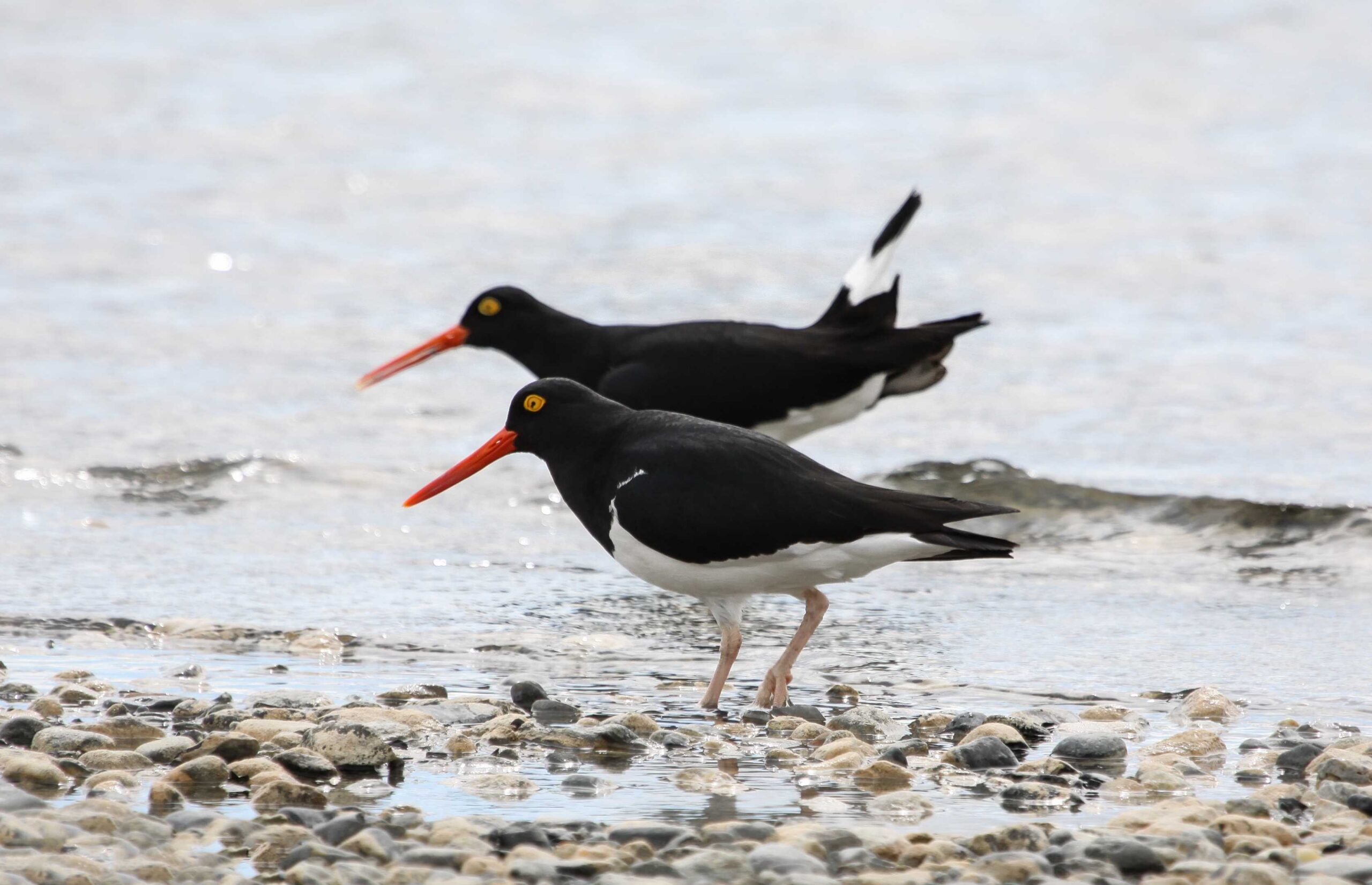
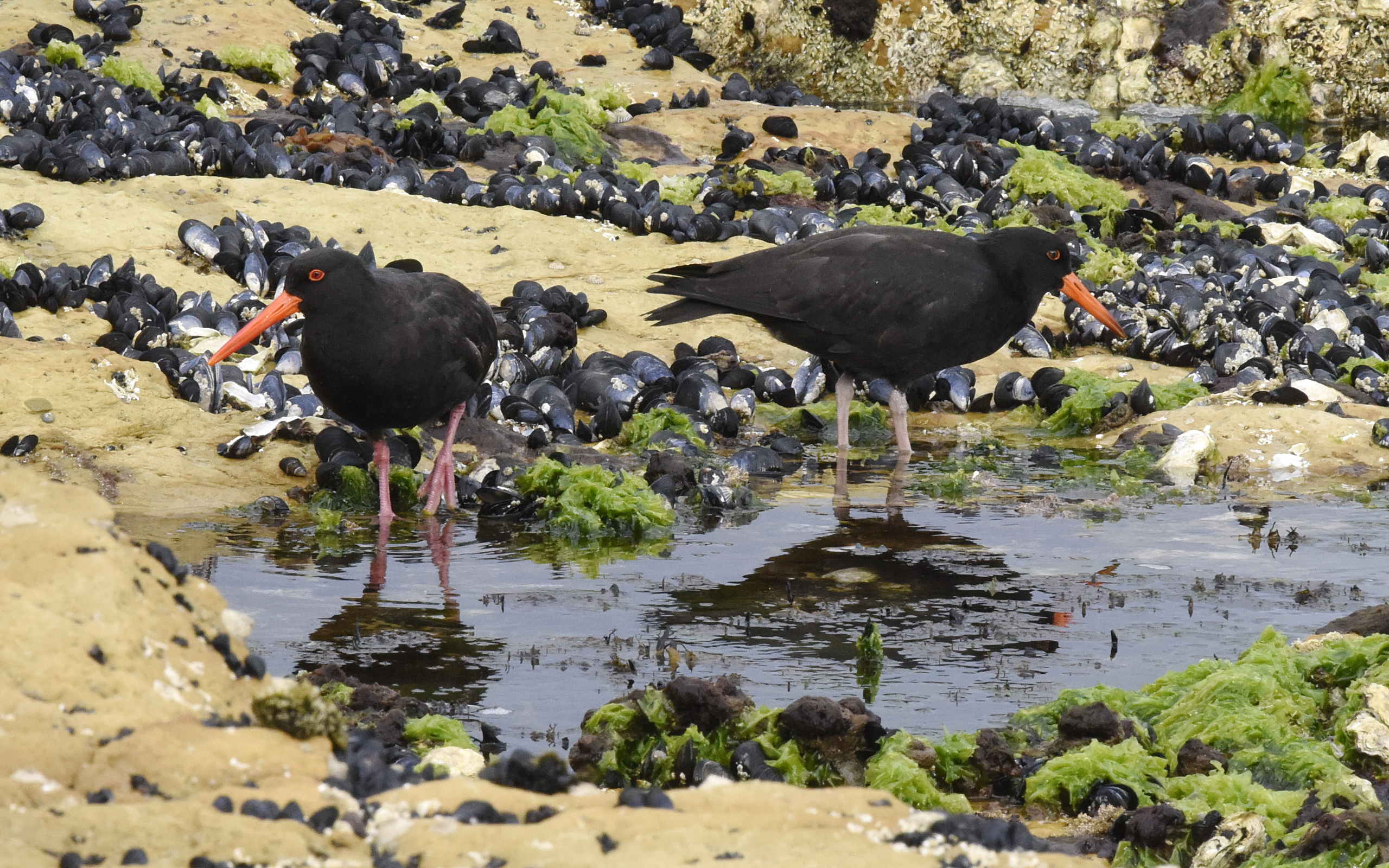
Oystercatchers
Family: HAEMATOPODIDAE (Bonaparte 1838)
Genus: Haematopus – Latin; haematopus bloodfoot – from the Greek; haima blood; pous foot (Linnaeus 1758).
Some videos on You Tube about Oystercatchers: Eurasian Oystercatcher / Common Pied / Palaearctic Oystercatcher [Haematopus Ostralegus] – YouTube
Distribution
- Europe: Eurasian Oystercatcher.
Africa: African, Canary Islands and Eurasian Oystercatchers.
Asia: Eurasian Oystercatcher.
Australasia: Pied, Sooty, South Island Pied, Variable and Chatham Oystercatchers.
North America: American Oystercatcher and Black Oystercatcher.
Central and South America: American Oystercatcher, Magellanic Oystercatcher, Blackish Oystercatcher and Black Oystercatcher.
Current Taxonomy: Three species. Painted-snipes are closely related to jacanas and are commonly placed in a superfamily with them called Jacanoidea.
- One genus Haematopus of twelve species. Six species are black-and-white, five species are all black and one species is variable between the two.
- Eurasian Oystercatcher Haematopus ostralegus (Linnaeus 1758)
- ∗ H. o. ostralegus (Linnaeus 1758)
- ∗ H. o. longipes (Buturlin 1910)
- ∗ H. o. osculans (Swinhoe 1872)
- South Island Pied Oystercatcher H. finschi (Martens 1897)
- Pied Oystercatcher H. longirostris (Vieillot 1817)
- Chatham Oystercatcher H. chathamensis (Hartert 1927)
- Magellanic Oystercatcher H. leucopodus (Garnot 1826)
- American Oystercatcher H. palliatus (Temminck 1820)
- ∗ H. p. palliatus (Temminck 1820)
- ∗ H. p. galapagensis (Ridgway 1886)
- African Oystercatcher H. moquini (Bonaparte 1856)
- Canary Islands Oystercatcher H. meadewoldi (Bannerman 1913)
- Sooty Oystercatcher H. fuliginosus (Gould 1845)
- ∗ H. f. fuliginosus (Gould 1845)
- ∗ H. f. opthalmicus (Castelnau & Ramsay 1877)
- Black Oystercatcher H. bachmani (Audubon 1838)
- Blackish Oystercatcher H. ater (Vieillot & Oudart 1825)
- Variable Oystercatcher H. unicolor (Forster 1844)
Past Taxonomy: Has been very confusing due to this families apparent affinities to other groups such as rails and true snipes.
- Two forms no longer valid;
1) ‘Frazar’s Oystercatcher’: H. frazari (Brewster 1888) – 3 specimens to the north of La Paz on the gulf of California, Mexico. Probably a hybrid swarm, some authorities consider it a subspecies of H. palliatus. Proposed subspecies durnfordi and pitanay are also considered doubtful for the same reasons.
2) ‘Northern Oystercatcher’: H. reischeki (Rothschild 1899), New Zealand. Mixed plumage Variable Oystercatchers were given the specific name H. reischeki but there existed, then, a third taxon which was called ‘Black Oystercatcher’ H. unicolor which was thought to be separate from the black versions of the Variable Oystercatcher as it was more glossy in appearance.
3) Proposed races malacophaga (Iceland and Faeroes), occidentalis (British Is) and buturlini (Turkmenistan and S Kazakhstan) are probably insufficiently distinct to warrant recognition. Has been suggested that populations as far W as NW Adriatic pertain to race longipes.
Bibliography
- 1) Canary Islands Oystercatcher H. meadewoldoi now thought by some authorities to possibly be a colour morph of Eurasian Oystercatcher.
2) ‘Galapagos Oystercatcher’ H. p. galapagensis possibly distinct species (currently subspecies of H. palliatus).
3) Sooty Oystercatcher could be two species, the northern form being split as ‘Spectacled Oystercatcher’ H. opthalmicus (Castelnau & Ramsay 1877).
Bibliography
- BirdLife International: IUCN Red List for birds. Downloaded from http://www.birdlife.org on 26/03/2020
- del Hoyo, Josep, Andrew Elliot & Jordi Sargatal: Handbook of the Birds of the World – Vol. 3 (1996)
- Hayman, Peter, John Marchant & Tony Prater: Shorebirds – An identification guide to the waders of the world (1986)
- Jobling, James A.: Helm Dictionary of Scientific Bird Names (2010)
- Seebohm, Henry: The Geographical Distribution of the Family Charadriidae, or, The Plovers, Sandpipers, Snipes, and Their Allies (1888)
Click on an image for more information about the individual species.