

The Wader Guru
What is the Wader Guru?
The Wader Guru is your one-stop shop to ask all things waders.
If you have a question that you would like to put to the Wader Guru, submit it below, and we’ll come back to you. We may also publish your question in our quarterly newsletter.
Scroll down to read our FAQs and some recent questions, and to learn more about the Wader Guru panel.
Submit your question below
What is the difference between ‘waders’ and ‘shorebirds’?
SHORT ANSWER: Nothing the two words are synonymous.
LONG ANSWER: Whilst wader and shorebird are synonymous when referring to the group of birds in the sub-order Charadrii, they can mean different things in different places. For example, in the Americas where the Charadrii are generally referred to as shorebirds, the term wader is also in wider use but refers to any bird that wades. This includes birds such as herons, ibises, storks spoonbills etc. Conversely, elsewhere, particularly in the UK, although shorebird is widely understood to mean the same as wader, there is some confusion in that shore birds (two words) are basically any bird that frequents the shore and can be anything from ducks, through waders, to terns, gulls and auks.
Some argue that wader is not a good term as not all waders, wade. This is certainly true but the counterpoint that not all shorebirds frequent the shore is equally true. As the taxonomists increased the number of species included within this suborder, then so did the variety of lifestyles present in the group. Now neither word is universally apt but their widespread use means that both are here to stay and there is actually no real alternative that makes any sense, given the range of species involved.
Neither shorebird nor wader is more correct than the other, so it is purely a matter of personal choice, or local custom, which determines the name you use. Some use both, as we do, but in the end they all refer to the same eclectic bunch of birds housed within the sub-order Charadrii.

Tringa nebularia;
A classic wader
© Elis Simpson
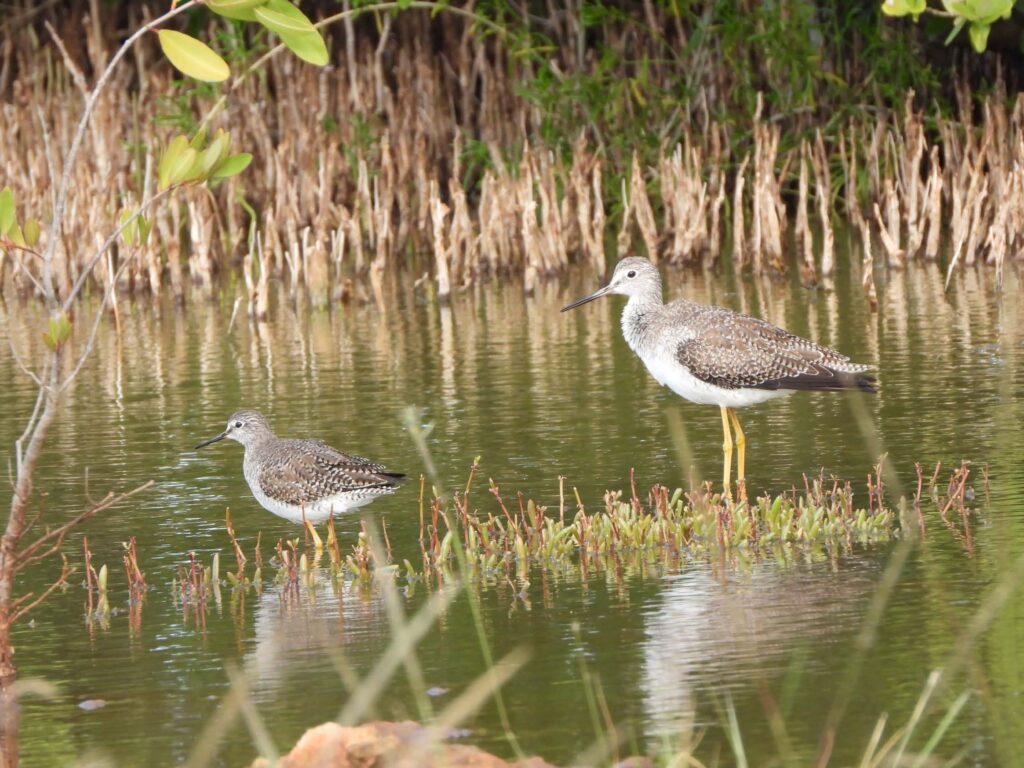
Tringa melanoleuca;
A classic shorebird
© Elis Simpson
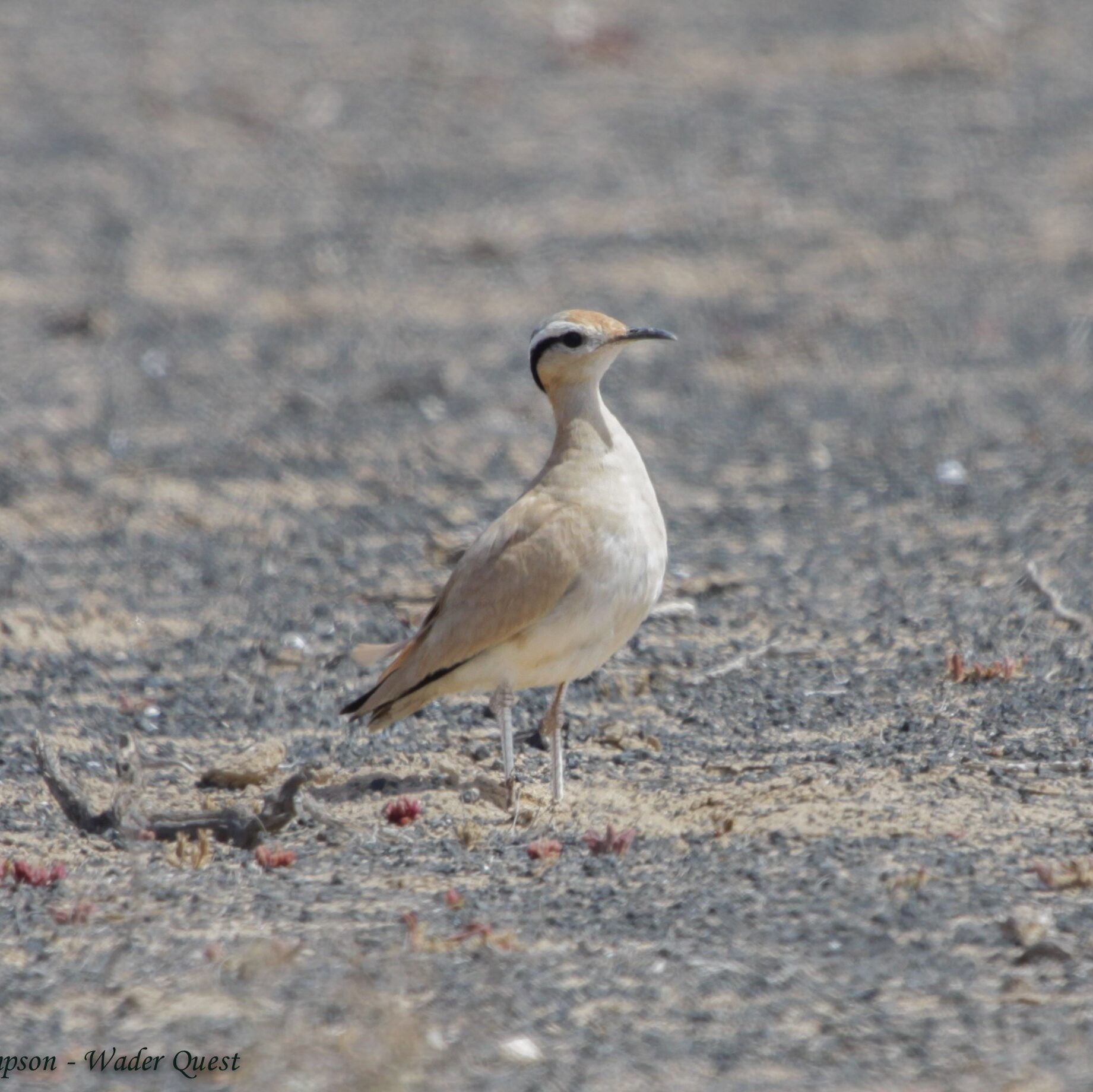
Cursorius cursor;
A non-wading wader
© Elis Simpson

Scolopax minor;
A shorebird that rarely frequents the shore © Knut Hansen
What is an ‘Inspiration’ of waders or shorebirds?
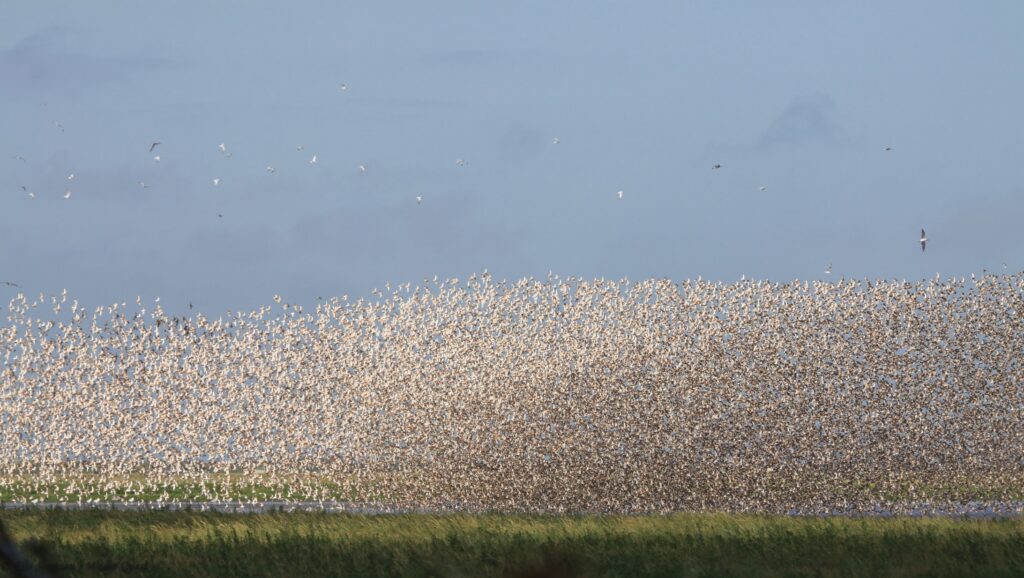
SHORT ANSWER: ‘An Inspiration of waders’ is the collective noun for a mixed or unidentified flock of waders swirling in flight over estuaries and anywhere waders gather in large numbers, around the world.
LONG ANSWER: What would you call a mixed or unidentified aggregation of wader species swirling in flight over your favourite estuary? What collective noun could do justice to these spectacular formations of birds tied together by invisible threads wheeling, swishing and pirouetting over an estuary when they rise up with a thunderclap of simultaneous wing beats, like dry leaves lifted from a forest floor by a sudden gust of wind.
Even if you have experienced this many times before, each time it feels different, an infinite number of shapes and forms painted like a living fresco in the vaulted ceiling of the cathedral skies above you. Just sitting there, in awe of this exuberant demonstration of the power and beauty bestowed upon the natural realm around us, it becomes clear that a world that did not contain such events would be an impoverished one indeed. Each of those birds will soon be risking everything to return to their breeding grounds to try, against the odds, to replace themselves before they die, simply to maintain their species.
So I ask again, what do you call this inspiring phenomenon? The most likely answer I would expect to hear would be ‘a flock of waders’. Waders though, have inspired us in so many ways throughout history in; art – from cave paintings, through the Egyptian frescos and the great masters to modern day artists; literature – from novels to works of fiction revolving around waders and their lives; poetry – from very ancient times to the present day; music – from classical to pop and some anthems written to certain species. In addition waders are represented in some of our myths and legends, ancient stories like that of the Easter Bunny to the urban legend that Egyptian Plovers feed in sleeping Crocodile’s mouths. These birds are steeped in our culture. Given this connection I put it to you that when you come across a multitude of them dashing as one, living, being over the estuary, describing impossible turns and manoeuvres, flashing from dark to light as they go, that calling them ‘a flock’ is inadequate. That collective noun may be suitable for a bunch of random sheep on a hillside or an unruly gang of pigeons in a town square, but surely not noble or expressive enough for our majestic waders.
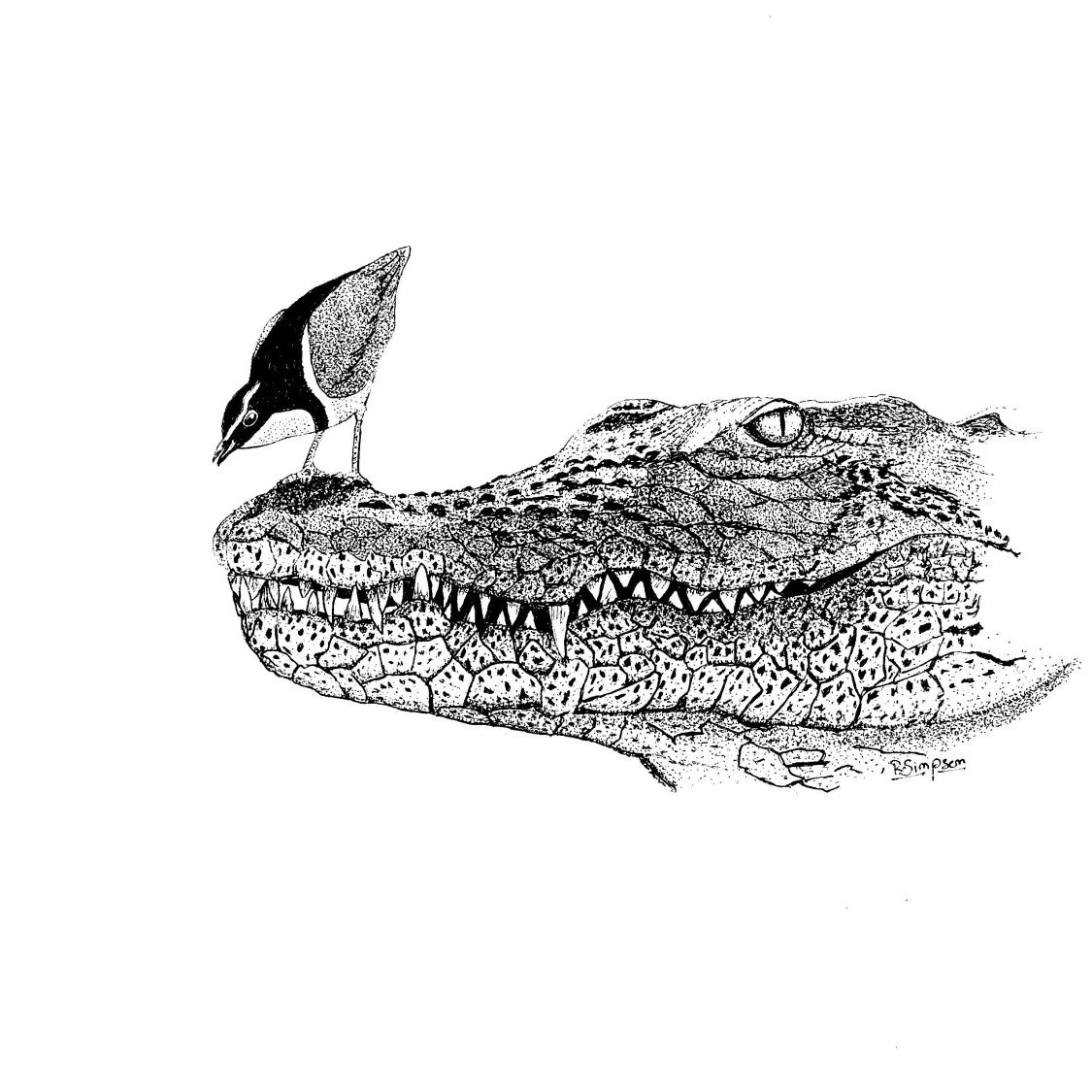
© Rick Simpson
What about calling it ‘a murmuration’, usurping the collective noun for European Starlings? That is overtly wrong and it would be no less wrong to usurp one that is used for a specific wader species that has inspired us to select, invent or adopt for them. Some of these are blindingly obvious, such as ‘a pack of knots’, some are rather insulting like ‘a deceit of lapwings’, others are entirely mystifying, witness ‘an omniscience of godwits’. We have collective nouns for many things, but somehow, one of the most striking and spectacular of life’s experiences with waders has hitherto gone unrecognised in this way.
Is this because we cannot be sure exactly what we are watching? What species make up these swirling gyrations? Often they may be just one species, maybe they are all Knots, in which case we could call it ‘a pack’, but can we be sure when watching so many birds at once that they are all the same? It might be that those Red Knots are actually Dunlins, or Knots and Dunlins, in the thousands of beating wings some may actually be attached to Bar-tailed Godwits and plovers, be they Common Ringed or Grey. Perhaps, unnoticed a few Sanderlings and Ruddy Turnstones are scooped up in the throng around the periphery or lost in the middle of the heaving mass of birds; now they defy our attempts to give them a name, and so it seems we have never tried.
But surely this is a phenomenon that deserves better? It is one of nature’s most engaging and breath-taking experiences to sit beside an estuary and witness this tableau in motion. This is an entreaty to the world at large to give this amazing spectacle a name. So what are we to call this mixed or unidentified group of waders speeding above the ebbing and flowing estuary waters? May I be so bold as to humbly submit that such magical gatherings of the birds that have been inspiring us since we came down from the trees, should be respectfully, and reverently, referred to as………………………….. ‘an Inspiration of Waders’.
How many species of wader/shorebird are there in the world?
SHORT ANSWER: There are 238 species of wader in the world.
LONG ANSWER: To know more about the different species of wader in the world, visit the Wader Directory, or click here to read more.
How many species of wader/shorebird are there in the UK?
SHORT ANSWER: There are 80 species on the official British Ornithologists’ Union list.
LONG ANSWER: Whilst there are currently 80 species on the British list you cant expect to see them all every year and one will never again appear on our shores, nor any other shores for that matter, due to being extinct. That unfortunate species is the Eskimo Curlew, which, as a result of it’s extinct status (Critically Endangered on IUCN list), is the only wader on the list not on Category A, but on Category B. Only 7 records exist of this once abundant bird of the Americas between 1852 and 1887. They must have occurred more often than reported when in their hey-day as their migration route follows that of the American Golden Plover that is a regular, if scarce, visitor. The last record was on the Isles of Scilly. The closely related, and equally unfortunate (for the same reason), Slender-billed Curlew is not on the official list, however, a number of people believe a record of this species in Druridge Pools, Northumberland on 4th-7th May 1998 is credible. It was originally accepted by the BOURC, but was later removed in 2014.
Which is the most endangered wader/shorebird in the UK?
SHORT ANSWER:
Most endangered breeder (rare): Purple Sandpiper
Most endangered breeder (steepest decline): Eurasian Curlew
Most endangered regular non breeder: Bar-tailed Godwit and Red Knot
Most endangered regular passage species: Curlew Sandpiper
Most endangered accidental: Sociable Lapwing
LONG ANSWER: This is actually a multi faceted question as endangered can have different connotations as far the status of a species in any one country is concerned. In the UK birds are categorised as Red, Amber or Green.
• Red List is a list of birds in most urgent need of our help. It includes some of our rarest birds, but also familiar birds, which have suffered huge declines.
• Amber is used to highlight birds whose conservation status is of moderate concern.
• Green represents species that are not in danger or declining rapidly
The first aspect is the most endangered breeding species. For this category we are considering those that regularly breed, discounting those that have historically bred or do so sporadically. Within this context there are two things to look at. One is the likelihood of the species becoming extinct in the UK in the near future, but which may or may not be threatened elsewhere, the other is the species which is declining most rapidly within the UK. For these answers we refer to the UK Red List and find that there are, alarmingly, 11 species of wader on that list. They are:
- Eurasian Curlew. Red Listed UK / Near Threatened Europe / Near Threatened Worldwide
- Northern Lapwing. Red Listed UK / Vulnerable Europe / Near Threatened Worldwide
- Black-tailed Godwit. Red Listed UK / Near Threatened Europe / Near Threatened Worldwide
- Ruff. Red Listed UK / Near Threatened Europe / Least Concern Worldwide
- Eurasian Dotterel. Red Listed UK / Least Concern Europe / Least Concern Worldwide
- Common Ringed Plover. Red Listed UK / Least Concern Europe / Least Concern Worldwide
- Eurasian Woodcock. Red Listed UK / Least Concern Europe / Least Concern Worldwide
- Purple Sandpiper. Red Listed UK / Least Concern Europe / Least Concern Worldwide
- Red-necked Phalarope. Red Listed UK / Least Concern Europe / Least Concern Worldwide
- Eurasian Whimbrel. Red Listed UK / Least Concern Europe / Least Concern Worldwide
- Dunlin. Red Listed UK / Least Concern Europe / Least Concern Worldwide
Which is the world’s biggest wader/shorebird?
SHORT ANSWER: The Far Eastern Curlew
LONG ANSWER: The largest wader in the world is the Eastern Curlew Numenius madagascariensis, which measures from tip of the bill to the end of the tail 166 cm. Of course they are not all that size, females are larger than males and they too vary in size. The figure of 166 is the largest in the range as generally accepted in the literature. However they are not hugely different in size to the Long-billed Curlew Numenius americanus, which measures just one centimetre shorter at 165 cm. Again this refers to the largest in the range and will be a female. Interestingly neither of these is the heaviest species in the world. That honour lies with another curlew, the Eurasian Curlew Numenius arquata. The heaviest recorded is a whopping 1360 grams. In second place weightwise is the Far Eastern Curlew narrowly less at 1350 grams. The second longest species, Longbilled Curlew, is relegated to third place being an altogether more delicate species, its length truly is in its bill, weighing in as 951 grams. Similar topics: Which is the world’s smallest wader/ shorebird? Sources: del Hoyo et al.: Handbook of the birds of the World Vol. III (1996) Hayman et al.: Shorebirds and identification Guide to the Waders of the World (1986)
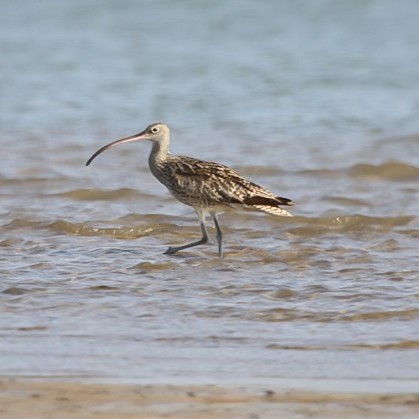
Numenius madagascariensis
© Elis Simpson
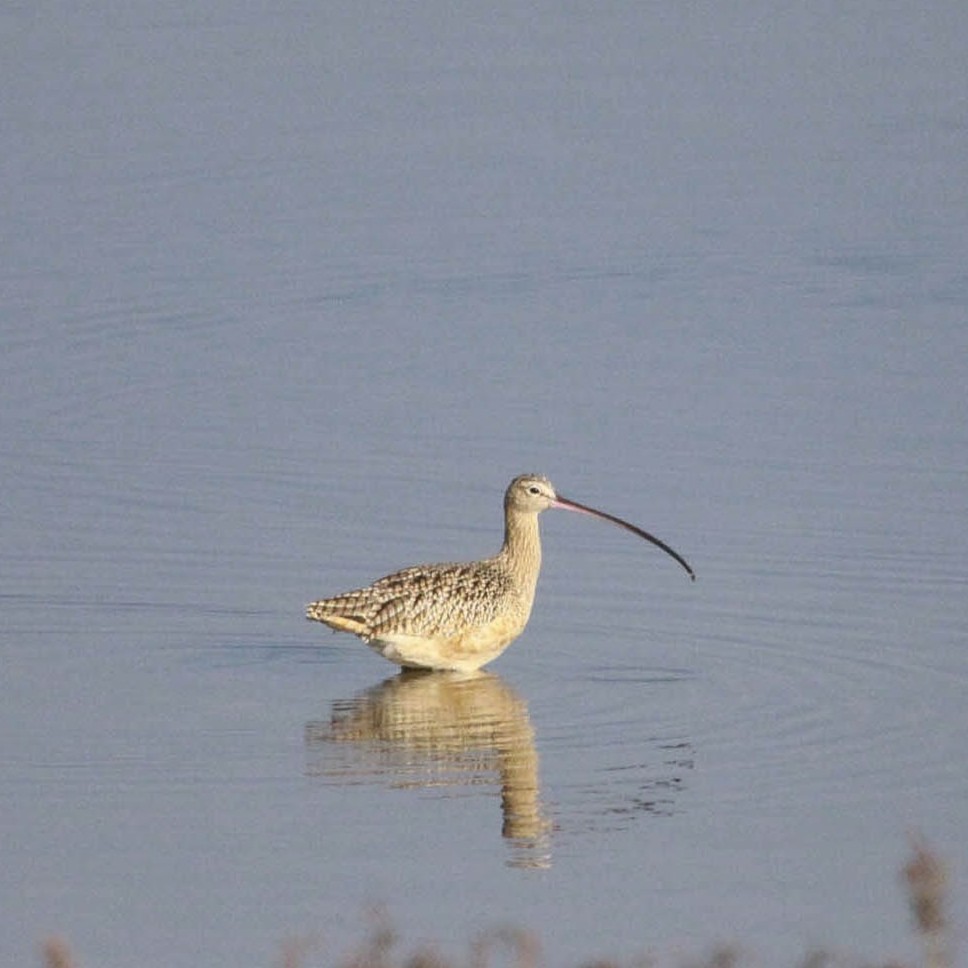
Numenius americanus
© Elis Simpson

Numenius arquata
© Elis Simpson
Which is the world’s smallest wader/shorebird?
SHORT ANSWER: The Little Stint
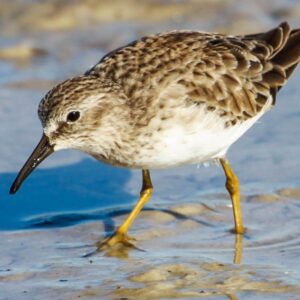
LONG ANSWER: The smallest wader in the world is the Little Stint, which measures just 12-14 cm from the tip of its bill to the end of its tail. cm It weighs in at a minimum (adult) of just 17 grams. This statistic is not however universally quoted and some authors have the Least Sandpiper as smaller.
Shorebirds of the Northern Hemisphere has all of the smaller Calidris Sandpipers as the same minimum length of 13 cm, but gives the wing span of Least Sandpiper as 28 cm and Little Stint as 30 cm, thus making Least the smallest. If we refer back to Witherby’s The Handbook of British Birds we find that in the measurements of the Little Stint and Least Sandpiper (which is referred to there as the American Stint) in wing, tarsus and bill, Least Sandpiper is consistently smaller. The Handbook of the Birds of Europe, the Middle East and North Africa – The Birds of the Western Palearctic has the following; Least Sandpiper 11-12 cm with a wing of 33-35 and Little Stint 12-14 cm and wing of 34-37. Whilst the comparative sizes of these species does vary, it is clear that in most cases the Least Sandpiper is indeed the smallest.
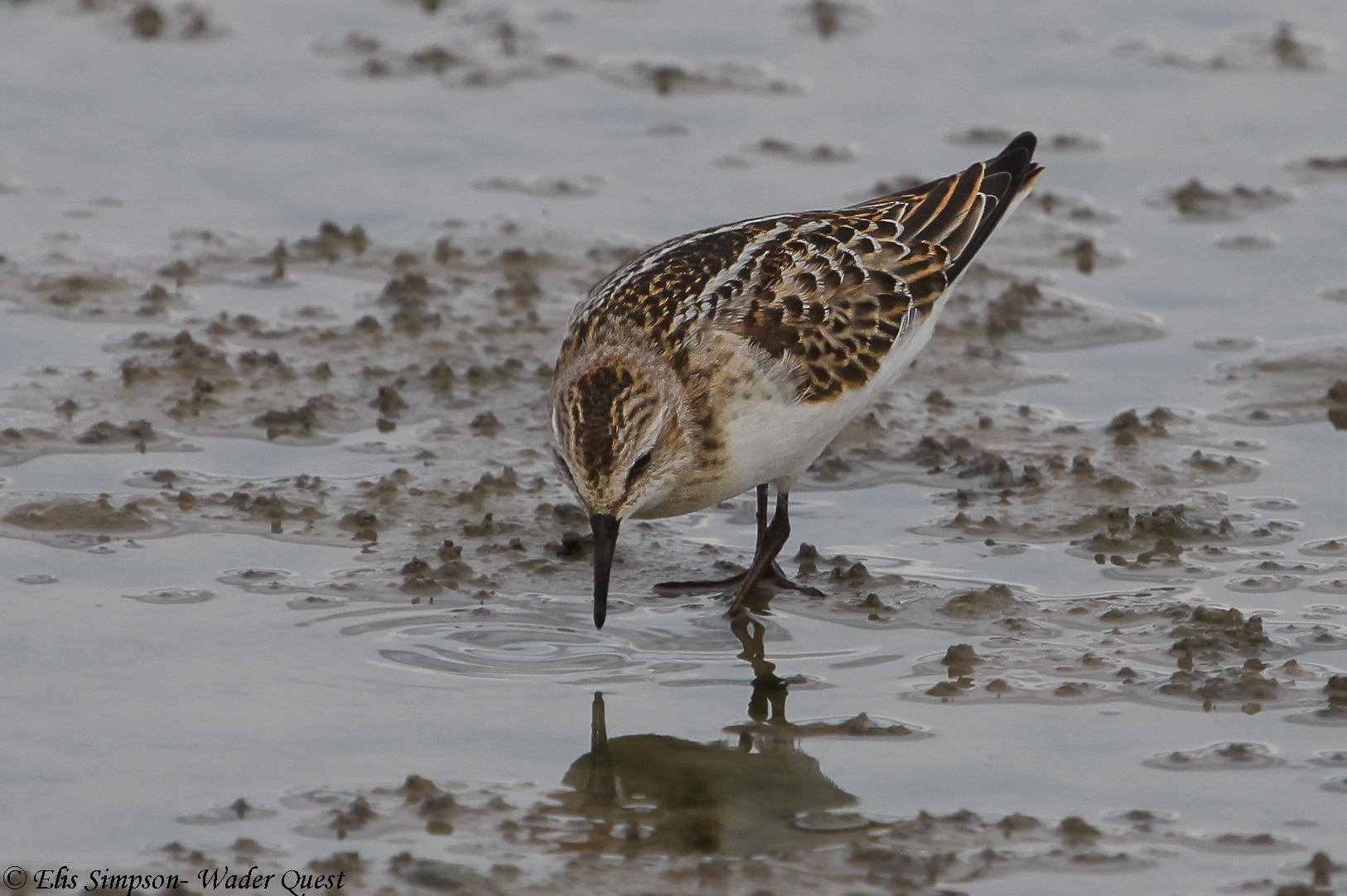
© Elis Simpson
© Elis Simpson
Sources:
Chandler: Shorebirds of the Northern Hemisphere (2009)
Cramp et al.: Handbook of the Birds of Europe, the Middle East and North Africa – The Birds of the Western Palearctic Vol III (1983)
del Hoyo et al.: Handbook of the birds of the World Vol. III (1996)
Hayman et al.: Shorebirds and identification Guide to the Waders of the World (1986)
Snow et al.: The Birds of the Western Palearctic Concise Edition Vol. I (1998)
Witherby et al.: The Handbook of British Birds (1940)
What is the longest flight ever recorded for a wader/shorebird?
SHORT ANSWER: 13,050 kilometres / 8,109 miles by a Bar-tailed Godwit.
LONG ANSWER: A Bar-tailed Godwit holds the record for the longest known, non-stop flight of any land bird. The birds of the subspecies Limosa lapponica baueri breed in Alaska and Siberia and winter in New Zealand and Australia. A satellite tracking study of these birds has been carried out by the Pukorokoro Miranda Shorebird Centre since 2007.
These godwits have a history of breaking records. The first t ime a flight from Alaska to New Zealand was recorded, and therefore proven, was in 2007 when a bird named E7 made the flight of 11,570 km / 7,190 miles in 8.5 days. That record was broken in 2020 by a bird known as 4BBRW, its title referring to the colour rings attached to its legs by researchers, when it arrived in New Zealand after a 12,199 km / 7,580 mile flight. However the same bird surpassed itself in 2021 when it ended up in New South Wales in Australia instead of New Zealand having travelled 13,050 km / 8,109 miles in just under 10 days. The flight had a duration of 239 hours with the bird averaging 55 kph land speed.
Further to this information concerning the longest direct flight, the same species (and subspecies) gets pipped at the post for the longest overall return flight of any wader. On average the distances travelled by the Godwit on its elliptical migration route can be around 29,000 km / 18,020 miles (see Fig 1). However the Red Knot, which travels between Arctic Canada and Patagonia each year, has a return trip of around 32,000 km / 19,884 miles. (see Fig 2.) One bird was known to live for at least 22 years and so in that time had travelled some 704,000 km / 437,445 miles. The distance from the earth to the moon is 384,400 km / 238,855 miles so this bird, once it had flown that distance, received the moniker ‘Moonbird’ and it then went on to fly almost the same distance back again. This famous bird had an eponymous book written about it.
What is a ‘Plover’s page’?
SHORT ANSWER: The Dunlin Calidris alpina is sometimes called ’Plover’s page’ because of its close association with the European Golden Plover Pluvialis apricaria.
LONG ANSWER: Associations between different wader species are not uncommon, especially in those species breeding in the Arctic tundra. There are two main reasons for this happening. A timid species may gain protection from a bolder species that is accustomed to giving a staunch defence of its territory against predators, or, one species may benefit from the other as an early warning system. Grey Plovers Pluvialis squatarola are one such bold species and they have smaller less feisty species sometimes nesting close to them (Curlew Sandpipers Calidris ferruginea for example) in order to benefit from this defence of a territory from predators by the stronger bird.
The European Golden Plover Pluvialis apricaria (hereafter Golden Plover) is not a bold species but is itself rather timid, so clearly that is not a reason for another species to associate with it. In the case of the Golden Plover, one species is particularly known to stick close to it, especially on the breeding grounds, and that is the Dunlin Calidris alpina. So frequent is this pairing that in some places the Dunlin has been named ‘Plover’s Page’ or ‘Plover’s Provider’. Indeed the name for Dunlin in Iceland is Lóuþræll, which means ‘Plover’s slave’.
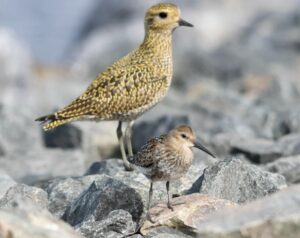
To understand why it is so named you need to understand historically what a page is, or does. In Medieval times it was a young boy between the ages of 7 and 14 who was in the service of a nobleman or knight. In return for clothing, board and lodging they would work without pay for the nobleman, who, in addition to keeping the boy fed and clothed, would be responsible for teaching him all the trappings and functions of nobility, with a view to the boy perhaps being knighted himself one day. As a result the page was in close attendance to the nobleman at all times, except in battle. Dunlins have been observed keeping in close contact with Golden Plovers in this way, giving the impression that they are ‘in the service’ of the Golden Plover. In fact, there is almost certainly no benefit to the Golden Plover at all and this relationship is probably detrimental to their well-being.
Are gulls classified as waders? If so why, if not why not?
The Guru’s answer: No, although gulls and waders are closely related, gulls do not form part of the group known as waders. The order Charadriiformes contains both groups of birds, but within it there are three suborders Charadrii (plovers and allies), Scolopaci (sandpipers and allies) and Lari (gulls and allies). Traditionally waders were classified as being in the two former suborders and therefore distinct from gulls which occur in the latter. Recently these clear lines have been blurred however.
What is the difference between whimbrels and curlews?
The Guru’s answer: There are two answers to this question depending on a) whether you are referring collectively to any birds called whimbrel and any called curlew or b) you are specifically asking about the Eurasian Whimbrel and Eurasian Curlew that occur in India.
a) Historically, the two species were given their names after the calls they make, so in terms of the name that is the difference between them. The name Whimbrel used to refer to a single species within the curlew family (Numenius). All other species within the family are called curlew (although one was formerly known as Little Whimbrel, now Little Curlew) but now that Whimbrel has been split into two species, Eurasian and Hudsonian, there are two species with that name. As whimbrels are, in fact, curlews, there are no differences other than those which identify each species.
b) The principal difference between Eurasian Whimbrel and Eurasian Curlew are: size (Curlew bigger); head pattern (Whimbrel with cap and central crown stripe, Curlew plain headed); bill length and shape (Whimbrel being shorter and kinked down towards the end, Curlew being more evenly curved and longer). They can also be told apart by their calls.
Does the female Eurasian Dotterel display? If not how are the honours for mating resolved?
The Guru’s answer: The short answer is yes; they do.
For more northerly breeding populations pairing starts before the birds reach their breeding grounds. In this case they will select flat areas where they gather, usually near water. Southern breeding pairs will reach their breeding grounds before they are paired, and it may be several days after arrival before the rituals begin.
Pairs are formed from ‘trips’ (the collective noun for a group of Dotterels). It is usual for the female to initiate proceedings. This is manifested in the frequent raising and re-folding of both wings, or maybe stretching a single wing whilst spreading the tail simultaneously, as she pursues a male that she is trying to separate from the trip. Sometimes the male will respond by raising his wings too.
Plover flocks all facing the same way when roosting: I have noticed that when roosting in flocks, plovers and lapwings all face the same way, why do they do this? Surely it would be safer if some looked behind them?
The Guru’s answer: These flocks will all be facing the same way for both safety and comfort. They will all be facing into any breeze or wind that is occurring at the time. If they need to take off suddenly to escape danger the airflow will already give them lift when they open their wings. Also the contours of their body, being streamlined for flight, reduce buffeting and prevent the ruffling of the feathers, which would allow cold air and even water to get into the downy feathers, thus causing the birds to lose precious insulation and body temperature.
Which sites around the world do you think have the best shorebird spectacles?
The Guru’s answer: Wow! That is a big question, for which there is obviously no short answer. So please take a look at the full answer which follows, which is not, an exhaustive list by any means.
Associative breeding of waders: We always wondered about the nesting situation of waders. Specifically, do different species nest together in the tundra? For example: Curlews, Sanderling, Knots, how close do they build their nests to each other?
The Guru’s answer: Of the species you mentioned, among the tundra breeding Curlews (Numenius), the Little Curlew N. minutus forms loose colonies. The Bristle-thighed Curlew N. tahitiensis has just a small population that only breeds in two areas. In those areas the Curlews nest close enough to one another that several broods will join together in creches, guarded by a small number of adults, sometimes only one male, but that group will always include the male of at least one of the broods involved. Hudsonian Whimbrels N. hudsonicus and Eurasian Whimbrels N. phaeopus tend to be solitary nesters. Sanderlings Calidris alba too are solitary and do not travel far with the chicks from their breeding site and Red Knots Calidris canutus, whilst also solitary, range beyond the breeding site for feeding once the chicks have hatched.
Mystery wader: I’m not very good at wader identification, but I’ve seen a mystery wader at my local reservoir (Thornton Reservoir) that I just can’t seem to spot with my very poor scope, but I hear it calling really loudly! I mistook it for a Kingfisher but when it flew out of the reeds it was definitely wader shaped! It flew just above the water, it had white underneath and greyish on the top, it flew with a stiff but manic flapping in action. It surprised me to see it as Thornton reservoir has no mud flats or anything (I call it a blue desert) so was totally shocked to see it there. Even with the water low, there are some mud flats but its easily accessible to dogs, unfortunately.
The Guru’s answer: You mentioned the Kingfisher-like call and the call of the Common Sandpiper does sound a bit like that.
Graham Appleton: UK (England) based – Graham has been studying waders since 1974, when he first joined the Wash Wader Ringing (now Research) Group. Initially a teacher and latterly Director of Communications at BTO, he now writes the popular WaderTales blog, summarising the latest shorebird science papers for a broader ornithological audience.
Keith Betton: UK (England)- Keith is a freelance PR consultant, writer, lecturer and occasional broadcaster. He is a keen world birder having seen over 8650 species in 115 countries. He has a particular passion for Africa and the Middle East, having been Chair of both the African Bird Club and the Ornithological Society of the Middle East. In the UK he is heavily involved in bird monitoring in Hampshire, where he is a past County Recorder and is Chair of the Hampshire Ornithological Society. He has been a Council Member of both the RSPB and BTO (of which he became a Vice President) and also the Cameron Bespolka Trust. Having made over 1000 television appearances (and 5000 on radio) Keith uses his media experience to train people working in conservation, and each year he trains staff around the world for BirdLife International. He lectures widely on To book him for a speaking appearance contact contact him via keithbetton@hotmail.com
Rob Clay: Paraguay based – Rob is the Director of the Western Hemisphere Shorebird Reserve Network and has been active in the field of migratory bird conservation based in the Western Hemisphere for more than 20 years.
Josh Jones: UK (England) based – Josh is editor of Birdwatch magazine. He has been an avid birder since a young age, with a particular passion for waders and gulls.
Vojtěch Kubelka: Czech Republic based
Tony Parker: UK (England) based – ex Assistant Curator of Vertebrate Zoology at World Museum Liverpool ex founder member of the Liverpool Bay Wader Study Group. Now spends time watching and recording live waders on the Mersey and Dee estuaries, vice chair of Cheshire and Wirral Ornithological Society and Mersey Estuary Conservation Group.
Adrian Riegen: New Zealand based – Adrian grew up in England and got interested in waders in 1969. He was briefly involved with Wash Wader Ringing (now Research) Group in 1970. He then spent four years birding around the world from 1972, settled in New Zealand in 1982 and has been involved with Pūkorokoro Miranda Naturalist;s Trust and Shorebird Centre since 1985. He has run the New Zealand Wader Study Group since 1986 banding E7 and other famous godwits. He has led wader expeditions to Yalu Jiang in China from 2004 and surveys of most of the North Korean West Sea (Yellow Sea) coast between 2009-2019. Currently (2021-22) writing daily updates of satellite tagged godwits posted on Pūkorokoro Miranda Facebook page. For twenty years Adrian has compiled the biannual New Zealand national wader censuses for Birds NZ.
Rick Simpson: UK (England) based – Co-founder with Elis Simpson of Wader Quest. Former Executive Committee member of the International Wader Study Group. Passionate about all things to do with waders but with a special interest in the history and culture surrounding them, nomenclature, and taxonomy. Co-author with Elis Simpson of Eury the Spoon-billed Sandpiper; An Inspiration of Waders & A Quest for Waders. Wader Quest links Facebook Instagram LinkedIn Twitter
Humphrey Sitters: UK based
Andrew Whitelee: UK (Scotland) based. Freelance ecologist and ornithologist (Schedule 1 licence holder). Former Wader Quest trustee and committee member. Working mainly in the Scottish Highlands and Islands carrying out ecological surveys and working to protect wildlife and the environment during large construction infrastructure projects. Interested in the way technology can solve environmental problems rather than add to them. LinkedIn Twitter Instagram.