
About Wader Quest
Wader Quest’s aims
To raise awareness about the challenges waders face in the modern world.
To raise funds to support wader conservation worldwide, especially those involving locally led community projects.

Waders are under more global pressure today than at any time in the past, particularly long-distance migrants that depend upon the intertidal zone for refuelling and resting. Nearly half (48%) of wader species, where a population trend is known, are in decline. That is why Rick and Elis Simpson set up Wader Quest in 2012.
We support Community Wader Conservation where local groups and communities, mostly volunteers, work to protect their local wader populations whether they are breeding, passage or non-breeding populations. We think of this as the conservation arm of ‘citizen science’ and believe it to be equally, if not more, important. We also believe that the cumulative effect of these small conservation projects is significant and it gives concerned people a real sense that they are able to become involved and that they are making a tangible difference in their own back yard to tackle an acute global ecological crisis.
We also assist with small research projects that struggle to find other funding by purchase of equipment and tools, particularly if they can show some sort of community involvement.
If you are concerned about the declining fortunes of our waders, and wish to help, then it is possible for us all to ‘do our bit’. We don’t expect everyone to be able to protect beaches and nests, nor liaise with farmers over when, and how, to cut their fields, not everyone is in a position to roll their sleeves up and get physically involved in this way. But, if you feel saddened by what is happening to our waders, and wish to be a part of saving them for future generations to enjoy and marvel at, then you can help by joining as a member, purchasing an item from our range of merchandise, or by making a one-off or regular donation.
By doing so, you will be helping us to support those who are in a position to directly help and protect our waders, and the environments in which they live.



- To promote, for the benefit of the public, the conservation and protection of waders or shorebirds and improvements of their physical and natural habitats; and
- To advance the education of the public regarding the conservation and protection of waders or shorebirds and their natural habitats.
We aim to demonstrate that waders are not just worth saving for the sake of saving them, but that they are an integral part of our ecosystem and that their well being and future are linked to the well being and future of all life forms on this planet, including our own.
We believe passionately in enabling people to become directly, or indirectly, involved in wader conservation. We promote this through locally led Community Wader Conservation projects, reinforcing the work that larger conservation organisations are carrying out. We advocate a combined effort and co-operation between people in local communities and conservation organisations, to protect the delicately balanced places that waders inhabit to prevent them from becoming degraded, polluted or destroyed altogether.
It is extremely important to raise the level of awareness about the crisis facing waders the world over. We aim to do this by promoting the enjoyment, understanding, and protection of waders by engaging people of all ages in birding, education, and conservation with a view to reversing negative trends in wader populations.
To accomplish these aims we will:
• Promote conservation strategies for the protection of waders and demonstrate the value of conservation to the community.
• Encourage others to educate their community about the benefits of preserving and enjoying waders.
• Support research into maintaining, restoring, and understanding wader populations, especially where this has a community involvement.
• Undertake fundraising when required, and we are able to do so, to support locally driven wader conservation initiatives.
Wader Quest Board of Trustees
Wader Quest is led by a team of Trustees offering a broad range of skills. The Trustees play an important role, providing guidance on the key decisions and direction taken by Wader Quest. In addition to their individual skills, the Trustees are all passionate about wildlife and its conservation and have a particular passion for waders.

Rick Simpson – Co-founder and Chair of Trustees
A life-long birder having followed a circuitous route to conservation from garden birder as a child, through local patch watcher, British birder, twitcher, world birder and bird guide. It was being a guide in Brazil that led to running local community and school conservation projects with his wife Elis in the Atlantic forest. In addition, he was involved for several years in making twice yearly survey counts of aquatic birds for the Contagem Naçional de Aves Aquáticas (CNAA) for Wetlands International in Brazil.
Rick volunteered at British Natural History Museum bird collection Tring and as a volunteer collector for MZUSP in Brazil. In addition, he has been a bird guide in the UK and Spain for Capital Birding Tours and in Brazil as Rick Simpson Birding Services.
Since returning to the UK Wader Quest has taken over his life, taking him and Elis around the world to six continents, birding on all nine flyways to see one hundred and seventy-eight species of wader; giving talks in many places along the way. Wader Quest has become a conservation effort for a group of birds about which Rick is passionate becoming more and more concerned about the pressures they face and the seemingly low profile their problems have among birders and other wildlife observers.
Rick has had many articles relating to waders and their conservation published and writes blogs and articles for the Wader Quest site, newsletter and the Rick Simpson Birding site. He is a sought-after speaker and amateur bird artist. With Elis he has published three books Eury the Spoon-billed Sandpiper (2016 later translated into Chinese and published in China 2019) for children aged 6-11; An Inspiration of Waders (2019); A Quest for Waders (2020).

Elis Simpson – Co-founder and Trustee
Growing up in Brazil with a strong connection to nature and love of pristine, wild environments. Elis became interested in photographing the beautiful birds of Brazil and is now rarely seen in the field without her camera although she insists that she is not a bird photographer but a birder who takes photographs; she always carries her binoculars too.
Starting in Brazil watching the destruction of the Cerrado near her home and latterly travelling the world Elis has become a passionate conservationist and her interest in waders has given that passion direction.
With Rick, Elis organised and ran conservation projects in Brazil, including community and school projects as well as the CNAA, twice annual, water bird counts for Wetlands International.
Elis is a prolific photographer with credits on many websites around the world and also in magazines and journals illustrating articles and papers many of which she has co-authored with Rick. With Rick she has also published three books Eury the Spoon-billed Sandpiper (2016 later translated into Chinese and published in China 2019) for children aged 6-11; An Inspiration of Waders (2019); A Quest for Waders (2020).
Elis keeps Wader Quest in touch with the world through social media on numerous Facebook, Instagram, LinkedIn and twitter pages.

Phil Hadley – Trustee
Phil recalls that his interest in birds began at a very early age while on a family holiday in the Norfolk Broads when, to his complete amazement, a majestic Grey Heron flew out right in front of him, a mightily impressive bird to a young seven-year-old and a single event which Phil believes sparked his lifelong passion for wildlife and the natural world.
Phil has an honours degree in Biochemistry and a Fellowship in the Institute of Biomedical Science and has recently retired after some 37 years in the Pathology Laboratories in the NHS.
Phil recalls that his interest in birds began at a very early age while on a family holiday in the Norfolk Broads when, to his complete amazement, a majestic Grey Heron flew out right in front of him, a mightily impressive bird to a young seven-year-old and a single event which Phil believes sparked his lifelong passion for wildlife and the natural world.
Phil’s first pair of binoculars together with the AA Readers Digest British Book of Birds quickly followed at Christmas, as did membership of the Young Ornithologists Club (the then youth branch of the RSPB). Phil travels extensively within the UK, Europe and beyond reaching destinations that always culminates with a ‘Bird List’.
Phil’s association with Wader Quest began some 3 years ago when he came across the charity while searching for information on the shocking declines in the numbers of breeding curlews in the UK and Ireland over the last 20 years. Indeed, words such as vulnerable, endangered and critically endangered have now become synonymous with many of the world’s wader species and this is one of the main reasons Phil joined Wader Quest and took up an active role in its governance.
When asked, Phil finds it very difficult to choose his favourite wader as there are so very many, but if pushed he will always choose the Eurasian Curlew, not just because they are Britain’s largest wader and in his opinion have the most beautiful of all bird calls, but because the current plight of this beautiful enigmatic bird is one of the reasons, through Wader Quest, he wanted to be involved in their protection and conservation.


Ray Heaton – Trustee
As a young schoolboy in the 1960s Ray Heaton witnessed the arrival of little ringed plover as a breeding bird on the colliery flashes in Lancashire. He was part of the Borsdane Wood study group and the Leigh Ringing Group. In the late 1960s Ray was a warden at the Osprey site at Loch Garten for the RSPB. He also assisted at Leighton Moss RSPB reserve when the first aerial bird counts established that large numbers of wintering species of waders used Morecambe Bay, showing it to be a site of international importance. Also at this time he was often to be found on the Mersey and Dee estuaries, especially at Hilbre Island, to see the wintering knots.
Ray has worked in museum natural history work and archaeology, also as a Curator and Conservation Officer, as a Field Studies Centre Warden, a college lecturer (Biological Sciences and Geology) and for the RSPB at Rainham Marshes in London. He holds post-graduate qualifications in Behavioural Ecology and has worked on a variety of ecological consultancy. He has carried out studies on primate behaviour, observing mainly great apes, and on bird behaviour, working mostly on flamingos. He is a Fellow of both the Royal Geographical Society and the Linnean Society and currently is working on recreating Darwin’s plant experiments. He has collaborated in the work and publication of scientific papers and articles and was researcher and co-author of the Good Zoo Guide (Collins 1991).
Originally elected a Trustee of Chester Zoo (North of England Zoological Society) he has for the past 20 years served as an elected Trustee, including a period as a Vice President, of the Zoological Society of London ZSL.
Extensive travels have enabled him to visit many habitat types and observe wild species in areas such as North America, Hawaii, Canada, East and West Africa, Japan, Sri Lanka, SE Asia, New Zealand, much of Europe and of course the UK.
Ray feels privileged to sometimes watch goshawk and sparrowhawk from his garden, though not many waders!
His favourite wader is the Spoon-billed Sandpiper. Ray became aware of this bird (and at the same time the ibisbill) more than 40 years ago before serious conservation work on these species started


Louise Hathaway – Trustee and Treasurer
Louise has been an accountant for 40 years, mainly in practice. Three years ago she decided to move up to the west coast of Scotland and renovate an old derelict cottage, which is still ongoing (never ending). She lives up here quietly with my two greyhounds in the middle of nowhere surrounded by nature and coastline. She joined Wader Quest in 2019 as the charity was seeking a Treasurer and she thought it would be a nice change from her usual work. She says “I was at the stage in my life when I could pick and choose what I wanted to be a part of and Wader Quest fitted just right”.
She says she is no bird expert, so her favourite wader is the Oystercatcher as she can recognise them and sees quite a few in her area.
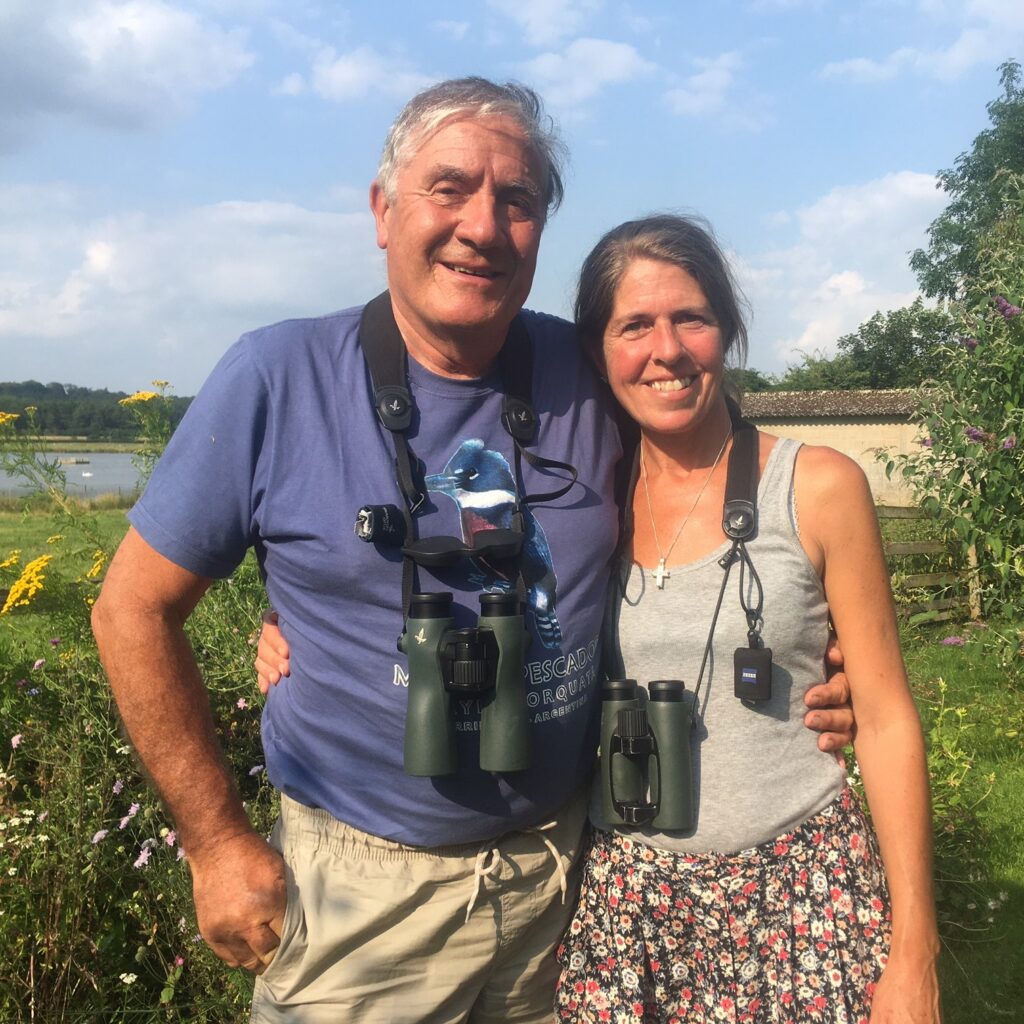
Tim Appleton MBE has had a lifelong career in conservation and management, his ethos is to bring people together, inspire them and help global conservation. Prior to creating and managing Rutland Water Nature Reserve, he worked for Sir Peter Scott at the world famous Slimbridge Wildfowl and Wetlands Trust and introduced Ospreys as a breeding bird to England to Rutland Water in 1996. He was co-founder of the internationally renowned British Bird Fair at which he ran for 31 years. Tim has been awarded an MBE as well as the Cadbury medal for services to conservation.
Penny Robinson has had a lifelong interest in all forms of wildlife, travelling to record and write about her experiences. Her role in Global Birding is vital and has ensured its success by her personal approach to hundreds of contacts, using her skills on all platforms of social media. Her dedication to detail has inspired folks to take part and help raise funds for conservation, but above all, helping to build our global community.
We are hugely grateful to our supporters and sponsors, whether as a member or donor.
Corporates


Very Photographic

Clubs


Bird Club

Ornithological Society
